

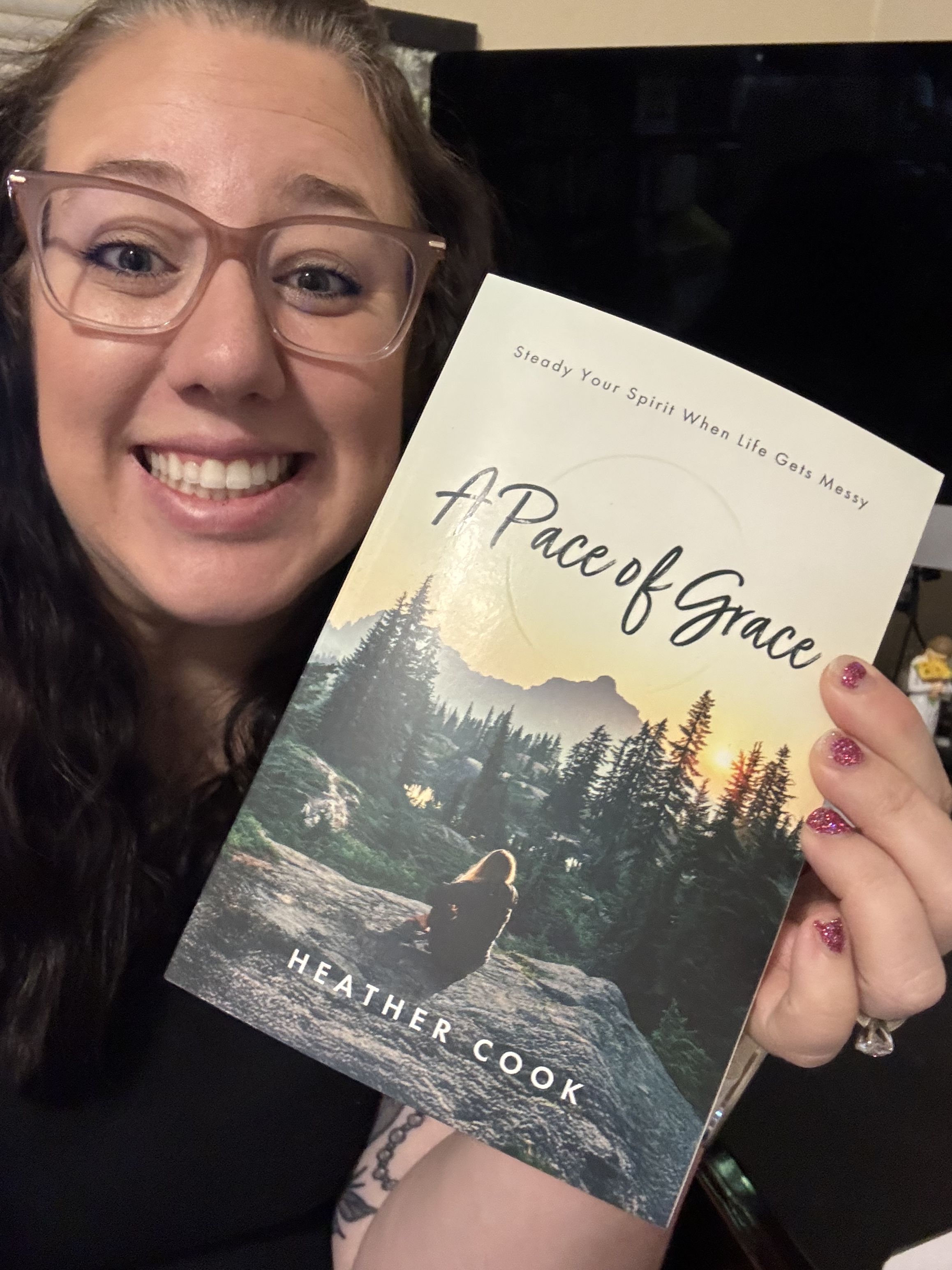


Surrender Is Where the Strength Comes From

There’s a moment I think every woman knows all too well—when life feels like it’s moving faster than your soul can keep up.

For me, it usually happens in the kitchen.
Half-drunk coffee…
Dishes stacked higher than I meant to let them…
A to-do list forming before I’ve even had a chance to breathe…

And in those moments, it feels like if I don’t push harder, hustle more, or hold everything together perfectly, it will all fall apart.

But here’s the truth I’ve been learning, slowly and gently:

Strength doesn’t come from holding everything together.
Strength comes from handing everything over.

In A Pace of Grace, I wrote:

“Surrender is hard, but it’s freeing.”

And I meant every word.
Because surrender didn’t come naturally to me.
It came through exhaustion.
Through anxiety.
Through the Holy Spirit whispering, “You don’t have to do this alone.”


**The world tells us to grit our teeth and push through.

Jesus tells us to lay it down.**

We live in a culture that celebrates self-sufficiency—
Do it all.
Be it all.
Carry it all well.

But Jesus invites us into another way entirely:

“Come to me, all of you who are weary and carry heavy burdens, and I will give you rest.”
(Matthew 11:28)

He doesn’t tell us to get stronger first.
He doesn’t ask us to clean up or pull ourselves together.
He simply says come.

Surrender is not weakness.
Surrender is wisdom.
It’s the moment we stop pretending we’re the Savior
and remember that we already have one.


A moment of surrender that changed everything

Not long ago, I found myself feeling stretched too thin, the familiar tightness of anxiety building in my chest as I stood in my kitchen with cold coffee and crowded thoughts. My mind was racing through everything I thought I wasn’t doing well enough.

Right there—in the middle of the noise—God whispered the same verse He’s been writing across my life:
“Be still, and know that I am God.”
(Psalm 46:10)

It wasn’t a command to pause my life allowing everything to magically get done.
It was an invitation.

An invitation to release my grip.
To stop forcing outcomes.
To trust that the God who holds the universe can hold me too.

Nothing around me changed instantly.
But I changed.
My breathing slowed.
My focus shifted.
My shoulders softened under the weight of His presence.

That is the power of surrender.


Surrender is not giving up — it's giving God room to move.

When we surrender, we make space for:

Peace that replaces panic
Clarity that quiets confusion
Strength that lifts what we cannot carry
Provision we couldn’t have manufactured
Joy we didn’t have to earn

Surrender takes us out of striving mode
and places us back into receiving mode.

This is the rhythm Jesus modeled, the rhythm our soul longs for.


A simple “Surrender Prayer” for your week

I want to give you a prayer straight from my own journal:

“Lord, I release what is not mine to carry.
I trust You with what I cannot control.
Lead me at Your pace today.
Make me aware of Your presence
and remind me that Your strength is enough for me.”

Pray it slowly.
Breathe deeply.
Let those words settle into every rushed and restless place.


How to Practice Surrender in Real, Everyday Ways

Here are a few gentle rhythms that make surrender practical:

1. Pause before you respond

Give the Holy Spirit space to lead instead of reacting from pressure.

2. Ask God: “What can I release today?”

Sometimes it’s a mindset.
Sometimes it’s a responsibility.
Sometimes it’s control.

3. Let the unfinished be okay

This one is hard… but so holy.
God never asked for perfection.
He asked for trust.

4. Move slowly on purpose

Slowness is a spiritual practice.
A way of saying, “God, I’m not in charge of the timing—You are.”


Surrender is where your strength returns.

When we stop trying to be the source and start trusting the Source, we find a strength that is steady, quiet, and deeply rooted.

The kind of strength that doesn’t fade when our day goes sideways.
The kind that doesn’t crumble when someone needs more than we expected.
The kind that isn’t dependent on us—but on Him.

This is the beauty of surrender:
It brings us back into the arms of a God who carries us.


A Note About the Book

If your heart feels weary or overextended, A Pace of Grace speaks directly to this place. In its pages, I share how God used surrender to reshape my pace, my peace, and my entire way of showing up in the world.

My prayer is that as you read it, you’ll feel less alone…
and more held by the One who loves you deeply.

Obedience Isn’t Heavy: It’s the Lightest Way to Live

If you’re anything like me, the word obedience used to feel a little… heavy.

Not because I didn’t want to follow God, but because somewhere along the way, I confused obedience with perfection.

I thought obedience meant getting everything right.
Holding everything together.
Never messing up.
Always proving that I could handle what God gave me.

But this is what God has been rewriting in my heart:

Obedience isn’t pressure. It’s freedom.
Obedience doesn’t weigh us down. It lifts us up.
Obedience isn’t God demanding more. It’s Him inviting us into His best.

In A Pace of Grace, I write:

“When I feel the familiar pull to strive, I remind myself that God doesn’t require perfection; He desires my heart.”

That sentence came from a real moment—one where I felt like I was failing at everything. And all God whispered was,
“Just walk with Me.”

Not run.
Not hustle.
Not prove.

Just walk.


Obedience is not a task — it’s a relationship.

When we think of obedience apart from love, it becomes rigid and exhausting.
But when we think of obedience inside our relationship with God, everything softens.

A daughter doesn’t obey to earn her father’s love.
She responds to love that already exists.

That’s what obedience feels like with Jesus.

It’s closer to:
“Lord, I trust You enough to follow You.”
than
“Lord, I’m trying to be good enough for You.”

Jesus said,

“My yoke is easy and my burden is light.” (Matthew 11:30)

If what we’re carrying feels suffocating, chances are… it’s not obedience.
It’s striving.

Obedience is God saying:
“Let Me lead you into peace. Let Me show you the way.”


A moment God used to teach me this

There was a day when I felt like I was juggling too many responsibilities—ministry, motherhood, deadlines, expectations, and the inner voice telling me I wasn’t enough. I sat in my car, mentally listing everything I didn’t get done.

I asked God, “Am I failing?”

And He answered so gently,
“No, daughter. You’re just trying to lead when I’ve asked you to follow.”

That stopped me.
Because He was right.

I had taken back the reins.
I was trying to run ahead.
I was hustling for approval God had already given.

Obedience wasn’t asking more of me—it was asking me to slow down.


Obedience begins with one simple question

Instead of asking:
“What do I need to get done today?”

Ask:
“Lord, what is mine to carry today?”

This question re-centers everything.

It clears the noise.
It lifts the shame.
It breaks off the striving.
And it reminds us that God doesn’t assign us a whole year at once.
He gives us today.

And He gives us the grace for today.


How to Practice Light-Hearted Obedience This Week

Here are a few simple rhythms you can try:

01. Ask God for your assignment each morning

Just one thing.
One act of obedience.
One next step.

02. Pay attention to what brings peace

Obedience aligns with peace, not panic.

03. Release anything God didn’t ask you to carry

Expectations, guilt, unnecessary responsibilities, old habits.

You don’t need to drag along what God already lifted from you.

04. Celebrate small yeses

Obedience is built on tiny steps of trust.

You don’t need a grand moment to be obedient.
You just need a willing heart.


The Sweet Truth About Obedience

Obedience is not God testing us.
It’s God guiding us.
Protecting us.
Forming us.
Freeing us.

And above all…
Obedience is love in motion.

The more we walk with Him, the more we realize this is the lightest way to live.


A Note About the Book

If this idea of surrender and “obeying without striving” speaks to you, Chapter 5 of A Pace of Grace goes deep into what I call Tenacious Grace — the grace that helps us cling to God even when the path feels uncertain.

I pray it blesses you when you read it.


When Your Soul Is Tired of Trying: A New Year Invitation to Surrender

There’s something about January that stirs up pressure, isn’t there?
A fresh start. A blank calendar. A brand-new list of expectations we quietly place on ourselves.

Everywhere we turn, the world tells us to hustle harder, set bigger goals, chase more, produce more, become more. And while there’s nothing wrong with goals or growth, I noticed something in myself these last few years: I didn’t need a new plan. I needed a new pace.

And not the pace the world tells me to run…
but the one God invites me to walk.

In A Pace of Grace, I write:

“Stillness doesn’t come from clearing my calendar but by filling my soul with Him, even in the chaos.”

That sentence came straight out of a season when my soul felt overextended—like I was trying to carry the weight of my life on my own shoulders. And friend… I don’t want to start another year like that. Maybe you don’t either.


Striving looks holy on the outside, but it drains us on the inside.

I used to think striving and obedience were the same thing—like if I didn’t give 110 percent, God would be disappointed. But striving is fueled by fear. Obedience is fueled by love.

Striving says:
“I have to prove myself.”

Obedience says:
“God, I trust You.”

Striving keeps us frantic.
Obedience keeps us free.
Striving puts the weight back on us.
Obedience puts the weight back on God.

As I prayed over this January, the Lord reminded me that a surrendered heart is far more powerful than a perfectly executed plan.


Maybe this year isn’t about doing more. Maybe it’s about releasing more.

Releasing control.
Releasing hurry.
Releasing the expectations we’ve been carrying for far too long.

Surrender is letting God lead instead of dragging Him behind us while we run.

And surrender becomes a doorway to peace.

When I finally stopped trying to “fix” my life through lists and schedules and leaned fully into Jesus, everything shifted. My circumstances didn’t magically change… but my heart did. My pace did. My awareness of His presence did.

Maybe the invitation for us this January isn’t to work harder but to breathe deeper.


A simple practice for this week:

5 Minutes of Stillness

I want to invite you into something small and sacred:

Take five minutes each day to sit with Jesus before you sit with the world.

Set a timer.
Sit in the quiet.
And pray, “Lord, I surrender this day to You. Lead me at Your pace.”

Don’t overthink it.
Don’t try to “do it right.”
Just show up. God loves showing up too.


This month’s heart posture: Surrender over striving

As we step into a new year, you don’t need to earn God’s love or prove your worth. You are already His daughter—chosen, loved, and held.

My prayer for you (and for myself) is this:

Lord, teach us to walk in step with You. Slow our striving. Steady our hearts. Let obedience be our joy and surrender be our strength.


A Note About the Book

If your heart is longing for a gentler pace this year—one filled with rest, presence, and freedom from striving—A Pace of Grace was written for you.

It will be available for pre-order, and I can’t wait to walk this journey of surrender and obedience with you each step of the way.

The Gift of Showing Up

“The Word became flesh and made his dwelling among us.”
— John 1:14

God didn’t stay distant. He showed up. He came near. He entered our world fully, tenderly, and personally.

At Christmas, we remember that Emmanuel—God with us—is not just a theological truth, but an invitation to love the same way: by being present, by showing up, and by walking with one another in grace.

December can be beautiful, but it can also be lonely. Even surrounded by people, so many are carrying quiet hurts, invisible burdens, and unspoken needs. And sometimes the greatest gift we can offer is simply showing up.

Not with perfect words.
Not with the “right” answers.
But with presence. With listening. With love.

Jesus came near to us—God with us. Emmanuel. And in a small way, we reflect His heart every time we choose to be with someone.

Showing up might look like:

• A text: “You came to mind today. I’m praying for you.”
• A coffee drop-off on a friend’s doorstep
• A few minutes of undistracted listening
• Holding space for someone’s story
• A simple prayer whispered for someone hurting

We don’t have to fix everything. We just get to be a reminder that they aren’t walking alone.

As the year closes, I’m thanking God for the friends who have shown up for me in big and small ways. And I feel the Spirit nudging me to do the same for others… quietly, faithfully, intentionally.

A simple practice for this week:
Ask the Lord to bring one person to mind—and reach out to them today.

Sisterhood of Grace Invitation

Showing up for one another is one of the ways we reflect the heart of Jesus. In the Sisterhood of Grace, we hold space for joy and hardship, faith and questions, celebration and grief—all of it.

If you’re longing for genuine community rooted in grace, I hope you’ll join us.

A Sisterhood of Grace Facebook Group

Choosing Presence Instead of Pressure

“Glory to God in the highest heaven, and on earth peace to those on whom his favor rests.”
— Luke 2:14

The angels didn’t announce Jesus’ arrival with urgency or pressure—but with peace. A peace meant for ordinary people in ordinary places.

Yet somehow, in the weeks leading up to Christmas, peace is often the first thing we sacrifice. This season, I’m learning that choosing presence is one of the most sacred ways we respond to God’s gift of peace.

Every December, I feel the pull to make everything magical—perfect gifts, perfect memories, perfect moments. But somewhere between the pressure and the Pinterest expectations, I lose the presence I actually long for.

I’m learning that my family doesn’t need a “more impressive” Christmas…
They need a more present me.

The gift of presence looks like:

• slowing down the schedule
• choosing peace instead of perfection
• saying yes to connection and no to pressure
• embracing the joy in simple, ordinary moments

When I read about the night Jesus was born, it wasn’t extravagant. It wasn’t polished or curated. It was quiet. Simple. Peaceful. And God was right there.

I want my home to feel like that this Christmas—
Not busy, but full of peace.
Not loud, but full of love.
Not rushed, but rooted in the presence of Jesus.

This week, I’m intentionally simplifying one tradition so we can create space for joy instead of stress. And I wonder… is there something you feel invited to loosen your grip on, too?

A simple practice for this week:

Name one tradition or expectation you can simplify so you can enjoy the moment instead of managing it.

Sisterhood of Grace Invitation

Showing up for one another is one of the ways we reflect the heart of Jesus. In the Sisterhood of Grace, we hold space for joy and hardship, faith and questions, celebration and grief—all of it.

If you’re longing for genuine community rooted in grace, I hope you’ll join us.

A Sisterhood of Grace Facebook Group

Small Moments, Sacred Invitations

“But Mary treasured up all these things and pondered them in her heart.”
— Luke 2:19

While the world hurried on around her, Mary paused. She noticed. She held the moments close and allowed God’s work to sink deep into her heart.

Advent invites us into that same posture—noticing God’s presence in the small, ordinary moments we’re often tempted to rush past. The Spirit is still speaking… often softly… and always close.

I’ve been paying attention this week—truly paying attention. And what I’m noticing is how often God speaks in the small places. Not the spectacular ones. Not the spotlight moments. But the quiet, ordinary spaces of daily life.

A soft whisper while loading the dishwasher.
A nudge during a drive across town.
A moment of peace while folding laundry.
A surprising tenderness in the middle of a chaotic morning.

It’s as if the Holy Spirit is saying, “I’m here too. You just have to notice.”

We talk about wanting to experience God in December, but sometimes we miss Him because we’re looking everywhere except the moment right in front of us. We expect Him at the candlelight service, but forget He meets us while we’re wrapping gifts or wiping down counters.

This is a season filled with sacred invitations—little moments woven into our days where God is offering His nearness.

What if we didn’t rush past them this year?

For me, slowing down isn’t about doing less for the sake of minimalism. It’s about creating enough space inside to recognize when the Spirit is whispering, “Pause… I’m here.”

A simple practice for this week:

Take 3–5 minutes each day to sit in quiet stillness and ask, “Holy Spirit, what are You doing around me today?”


Sisterhood of Grace Invitation

One of the ways I practice noticing God is by listening to how He’s moving in other women’s lives. In our Sisterhood of Grace community, we share those small, sacred moments—the whispers, the prayers, the questions.

If you’re hungry for a space where slowing down and spiritual formation are encouraged, you’re welcome there. Join us a Sisterhood of Grace Facebook Group here!

Making Room: Preparing My Heart for a Spirit-Led Season

“She wrapped him in cloths and placed him in a manger, because there was no guest room available for them.”
— Luke 2:7

There wasn’t room for Jesus in the inn that night—only space in a humble manger, simple and unexpected. Yet it was there, in the quiet and the unspectacular, that God chose to enter the world.

As December begins, I find myself asking a gentle but necessary question: Am I making room for Jesus in my own life? Or has my pace filled every corner of this season?


December has a way of sweeping us up into more—more plans, more gatherings, more expectations, more to do. And if I’m honest, I’ve spent many years arriving at Christmas morning with a tired heart and a scattered spirit. The season meant to draw me closer to Jesus somehow pulled me in every other direction.

But this year, I feel the Spirit gently inviting me to prepare differently.

Instead of filling the month, I want to make room.
Instead of moving quickly, I want to move quietly.
Instead of letting the world set the pace, I want to let Jesus lead.

When I look at the Christmas story, one line always catches me: “There was no room for them.” No room for Mary, Joseph, or the Savior of the world. And I can’t help but wonder… how often do I unintentionally do the same? How often does my pace leave no room for Jesus to actually meet me?

So I’m choosing a slower posture this December. I want to notice God in the everyday moments—the quiet mornings with coffee, the soft glow of Christmas lights, the laughter of my girls in the next room. I want to feel the Spirit’s nudge in my spirit before I feel the pull of my to-do list.

Maybe you feel the same longing.

If so, let’s prepare our hearts together. Let’s make room for a Spirit-led season… one slow, surrendered moment at a time.

A simple practice for this week:

Ask the Lord, “What is one thing I can release so I have space for You?”
And then actually release it.


Sisterhood of Grace Invitation

If you’re craving a slower, more intentional December—and you want to walk through it with other women who are choosing presence over pressure—I’d love to invite you into our Sisterhood of Grace Facebook community. Join us here!

It’s a space for encouragement, prayer, gentle conversation, and reminders that God meets us in the middle of real life. No striving. No pretending. Just women learning how to live rooted in Christ together.

Thankfulness That Isn’t Circumstantial

Give thanks in all circumstances; for this is God’s will for you in Christ Jesus.
— 1 Thessalonians 5:18

Life doesn’t always go the way we expect.
Sometimes, the prayers we pray aren’t answered how we hoped.
Sometimes, doors close that we thought would open.
And sometimes, we’re left standing in the in-between—trusting that God’s goodness is still true, even when we can’t see it yet.

It’s in those moments that our gratitude is tested.

It’s one thing to be thankful when life feels good—when prayers are answered, relationships are strong, and things seem to fall into place. But the real transformation happens when we learn to give thanks not because life is perfect, but because God is faithful.


Gratitude That’s Grounded, Not Fragile

Circumstantial thankfulness is fragile—it sways with our emotions and depends on outcomes.
But gratitude that’s rooted in God’s character? That’s unshakable.

When we understand that gratitude isn’t about pretending everything is okay, but about trusting the One who is okay, everything shifts.

In A Pace of Grace, I talk about what it means to live anchored in who God is, rather than what we do or what we have. This is that same kind of anchoring—it’s the kind of gratitude that says,

“Even when I don’t feel it, even when I don’t see it—You are still worthy of my thanks.”

That kind of thankfulness grows deep roots. It’s not surface-level or seasonal; it’s spiritual. It endures storms because it’s planted in the soil of God’s faithfulness.


When Gratitude Feels Out of Reach

There have been times in my life when gratitude didn’t come naturally—when it felt like a discipline rather than a delight.

In those seasons, I learned that sometimes the most powerful prayers are the simplest ones:

“Lord, help me to see You here.”

Because gratitude isn’t about ignoring the pain; it’s about acknowledging God’s presence within it.
It’s saying, “Even in this, I know You are good.”

Paul’s words in 1 Thessalonians 5:18 don’t tell us to give thanks for all circumstances, but in them. There’s a big difference. Gratitude doesn’t mean we’re thankful for loss, pain, or confusion—it means we’re choosing to trust that God’s goodness hasn’t changed, even when our situation has.


The Steadiness of God’s Character

When everything else in life shifts, God remains steady.
His love doesn’t depend on our performance. His grace doesn’t run dry. His faithfulness doesn’t falter with our circumstances.

When we root our thankfulness in who He is, we find a steadiness that no situation can shake.

This kind of gratitude looks like peace in the middle of uncertainty.
It looks like worship in the waiting.
It looks like hope in the heartbreak.

Because when our gratitude is anchored in God’s character, we can face anything and still say, “It is well with my soul.”


The Practice of Steady Gratitude

One of the ways I’ve learned to nurture this kind of thankfulness is through stillness—slowing down enough to notice the small reminders of God’s presence.

It’s easy to overlook them when life feels heavy:
The quiet sunrise that whispers new mercy.
The unexpected text that lifts your spirit.
The Scripture verse that meets you exactly where you are.

Gratitude in hard seasons often starts with something small—one whispered “thank You” that grows into another.

When we take time to pause, to reflect, and to remember His goodness, it realigns our hearts.
Even when circumstances shift, our confidence in His love does not.


A Gentle Challenge

This week, take a moment to reflect:

  • What are you thankful for that has nothing to do with your circumstances?

  • How has God shown Himself faithful, even when life didn’t go as planned?

  • Where have you seen His steady hand at work in your story lately?

Write them down. Speak them out loud. Share them with someone else.
Because gratitude that’s spoken has power—it changes the atmosphere around us and reminds our hearts of what’s true.


A Prayer of Thankfulness

Lord, thank You that my gratitude doesn’t depend on what’s happening around me, but on who You are within me.
Thank You that Your love never fails, Your promises never change, and Your presence never leaves.
Teach me to be thankful in every circumstance—to trust that You are good, even when life feels uncertain.
Let my heart remain steady in Your faithfulness, and may my gratitude become a reflection of Your grace.
Amen.


🌿 A Place to Belong

If you’re learning to cultivate this kind of steady gratitude—one that’s rooted in who God is, not what’s happening around you—we’d love to walk with you. Join our community of women who are learning to live with thankful hearts, no matter the season.
👉 Join our Facebook community here.

Thankfulness That Brings Abundance

“You crown the year with Your goodness, and Your paths overflow with abundance.”
— Psalm 65:11

There’s something about gratitude that changes the way we see everything.
When we start to notice God’s fingerprints in the everyday moments—our morning coffee, a child’s laughter, a sunset after a long day—our hearts begin to shift. What once felt small starts to feel sacred. What once felt ordinary becomes evidence of God’s extraordinary grace.

It’s not that life suddenly gets easier. It’s that our perspective changes.
Because when gratitude fills our hearts, scarcity loses its grip.


The Mindset of Scarcity vs. the Posture of Gratitude

For a long time, I lived with a quiet sense of scarcity—always feeling like I needed to do more, be more, have more. I’d look at others’ success or blessings and feel like mine didn’t measure up.

But here’s what I’ve learned: gratitude and comparison can’t coexist.
When you’re truly thankful, you stop counting what’s missing and start celebrating what’s already there.

Psalm 65:11 says, “You crown the year with Your goodness, and Your paths overflow with abundance.” That word overflow paints such a vivid picture—it’s not a trickle of blessing, it’s a river. God’s goodness doesn’t run out; it keeps flowing, even when we can’t see it.

When we live with gratitude, we begin to recognize that abundance isn’t always about having more—it’s about realizing we already have enough.


Gratitude Multiplies What We Have

There’s a story in John 6 that I come back to often—the feeding of the five thousand. A young boy offered his small lunch of five loaves and two fish, and Jesus gave thanks.

That’s it. He gave thanks.
And what was small became more than enough.

It’s such a simple but powerful reminder: gratitude multiplies.
When we place what we have in God’s hands and thank Him for it, He transforms it into abundance—whether that’s time, energy, finances, or opportunities.

I’ve seen this in my own life again and again. Times when I’ve felt stretched thin or unsure how I’d manage, and yet God met every need—sometimes through provision, sometimes through peace.

Abundance isn’t just what’s in our hands. It’s what God does with our open hearts.


When Gratitude Leads to Obedience

In A Pace of Grace, I talk about how gratitude and obedience are deeply connected. When we recognize all that God has done for us, our natural response is to live from a place of trust and surrender.

Obedience becomes less about striving and more about aligning our hearts with His goodness.
We stop asking, “What if I give this up?” and start saying, “How could I not, after all He’s given me?”

Gratitude changes how we approach our callings, our work, and even our waiting seasons.
It turns our focus from “I have to” to “I get to.”
And in that shift, joy begins to bloom.


Abundance Isn’t Always What We Expect

Sometimes abundance looks like answered prayers and doors opening wide. Other times, it looks like peace in the middle of what feels like lack.

True abundance isn’t measured by what’s in your bank account or on your calendar. It’s measured by the fullness of your soul.

You might be in a season where everything feels uncertain—where resources are tight or dreams are delayed. But even there, God’s goodness is not absent. It might be showing up in small ways: a text from a friend, a moment of laughter, a breath of calm in the middle of chaos.

When we begin to thank God for those moments, we start to see that abundance has been surrounding us all along.


A Gentle Challenge

This week, I want to invite you to practice abundance thinking.
Instead of focusing on what’s missing, take a moment each day to write down what you already have.

Maybe it’s the comfort of home, the joy of family, the gift of health, or the peace that comes from knowing Jesus.

Ask yourself:

  • Where have I seen God’s goodness this week?

  • What can I thank Him for right now, even before I see the outcome?

  • How can I use what I already have to bless someone else?

Gratitude isn’t passive—it’s active. The more we thank God, the more aware we become of His presence in our daily lives. And that awareness is where true abundance begins.


A Prayer of Thankfulness

Lord, thank You for Your goodness that never runs out.
Teach me to see abundance not as more things, but as more of You.
Help me recognize the blessings You’ve already placed in my life and to hold them with open hands.
Let gratitude shape my days and overflow from my heart, so that others may see Your goodness through me.
Amen.


🌿 A Place to Belong

If you’re longing to live from a place of abundance and gratitude, we’d love to walk with you. Our community of women encourages one another to notice God’s goodness in every season and to live rooted in His grace.
👉 Join our Facebook community here.

Thankful Even When Our Hearts Are Broken

“The Lord is close to the brokenhearted and saves those who are crushed in spirit.”
— Psalm 34:18

There’s a strange kind of quiet that comes after loss—when the familiar rhythms of your days suddenly stop, and you’re left standing in the stillness, wondering what comes next.

I remember sitting at my desk for the last time after losing a job I deeply loved. It wasn’t just a job to me—it was a calling, a place where I had poured out my heart, my time, and my prayers. When it was gone, I felt like a part of my identity had been stripped away.

Everything that once felt steady now felt uncertain. I tried to hold it together, to trust that God had a plan, but my heart was heavy. Gratitude felt far away—almost out of reach.

And yet, it was in that broken place that I began to learn what true thankfulness really means.


Gratitude Isn’t Denial—It’s Trust

When our hearts are broken, we often think gratitude means pretending everything is fine. But biblical gratitude isn’t denial; it’s trust.

It’s saying, “God, I don’t understand this, but I believe You’re still good.”
It’s choosing to thank Him not for the pain, but in it.

When I lost my job, I felt disoriented. I didn’t realize how much of my worth I had unknowingly attached to what I did instead of who I was in Christ. It was humbling and painful, but it was also holy. Because in the stripping away, God began rebuilding my foundation on something stronger—Himself.

As I wrestled through disappointment, I found comfort in Psalm 34:18: “The Lord is close to the brokenhearted.” Those words reminded me that even when everything else felt distant, God wasn’t. He was right there, in the tears, the questions, and the quiet.


The Gift Hidden in the Loss

Looking back now, I can see that losing that job wasn’t the end—it was the beginning of something new. But I couldn’t see that at the time.

All I could see was what was gone.
What I didn’t know was that God was already writing the next chapter, one that would lead to deeper healing, clearer calling, and renewed trust.

The space I thought was empty was actually fertile ground.
It was the soil where God would grow new things—ministries, relationships, and opportunities I never would have pursued if I had stayed where I was comfortable.

Sometimes, gratitude begins not with joy but with surrender.
It’s a whispered, “Lord, even here… I thank You.”


When Gratitude Feels Like a Sacrifice

Hebrews 13:15 calls us to offer a “sacrifice of praise.”
That word—sacrifice—means it will cost us something.

When we’re heartbroken, thankfulness doesn’t come naturally. It requires faith. It’s a conscious choice to look for God’s hand even when we can’t see His plan.

During that season, I remember journaling prayers that were half tears and half thanks. I didn’t have answers, but I had Jesus. And somehow, that became enough.

The more I practiced gratitude, the more I realized it wasn’t changing my circumstances—it was changing me. My prayers shifted from “Why, God?” to “What are You showing me here?”

Gratitude began to soften the ache. It didn’t erase it, but it gave it purpose.


Thankfulness in the Midst of Becoming

In A Pace of Grace, I write about how God often meets us in the middle of our becoming—in the moments when life feels uncertain, but our faith is being stretched. This was one of those seasons.

Losing that job forced me to slow down, to listen, and to let God remind me that my value wasn’t in my title or productivity—it was in being His daughter.

I think that’s what gratitude does—it reorients our hearts. It pulls us out of the fog of self-pity and into the light of His presence. It reminds us that even when life feels broken, God is still working beauty into the pieces.

And isn’t that the heart of thanksgiving? Not that everything goes our way, but that we recognize God’s goodness hasn’t changed even when our world has.


A Gentle Challenge

This week, if your heart feels heavy, I want to encourage you to pause and ask:
Where can I thank God right here?

It might not be for what happened, but maybe you can thank Him for His nearness.
For the lessons you’re learning.
For the people who’ve walked beside you.
For the quiet that allows you to hear His voice again.

Write it down. Speak it out loud. Pray it through tears if you need to.

Because even in heartbreak, gratitude grows hope—and hope is what keeps us moving forward with faith.


A Prayer of Thankfulness

Lord, thank You for meeting me in the broken places.
Thank You that even when I don’t understand, You are still good, still near, still working.
Teach me to see Your hand in the hard things and to offer You my gratitude even when it feels costly.
Help me to trust that You are writing beauty into this story, one line at a time.
Amen.


🌿 A Place to Belong

If you’re walking through a hard season and need encouragement, you’re not alone. Our community of women is a space to find hope, healing, and connection. Come join us as we walk through life together and learn to see God’s goodness—no matter what season we’re in.
👉 Join our Facebook community here.